
Why people aren’t buying your product?
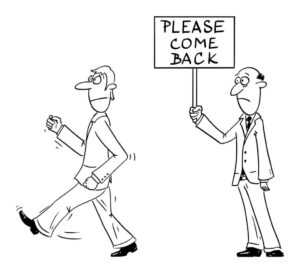
Have you ever wondered why people don’t pay attention to what you sell?
People have tons of things going on in their minds. Why would they listen to you? You spend time and money on marketing, advertising, and sales pitches, but most of these activities fail. It’s not always the money and length of your ad expense or sales pitch; it’s more about the skill of getting more customers’ attention and getting them interested in your product.
That’s the power of marketing. If you master it, you can do the same wonders.
You can get people to buy from you. So, let’s find out what the 3 things you should keep in mind when you want your customers to buy from you.
In 2007, I went to a shop to buy a laptop.
At that time, I had a Toshiba laptop. Now, I am not too sure if Toshiba is still making laptops or not. I was happy with the brand, but I needed to upgrade it for some reason. I went to the first shop, and I looked at different varieties of laptops of different brands. I was going to buy it for sure but could not decide which one was the right one for me. I needed help, and I was expecting a salesperson from that shop to help me.
I asked the salesman to help me in making a decision, and he started talking.
He went on and on with different models and features. He showed me 30 different varieties. He switched all laptops ON and demonstrated. I liked his support, but I didn’t feel comfortable. I was overwhelmed and got more confused than before. After 45 minutes or so, I walked out of the store without buying anything because I needed some time to decide. It was too much information for me to handle. A few blocks away, there was another shop that used to sell laptops and computers.
I went in, and in less than 20 minutes, I walked out with my new laptop. It wasn’t from Toshiba, but it was from Sony.
How suddenly I decided to buy in just 20 minutes?
What, this salesman of this second shop, has done something in just 20 minutes that the guy at the first shop could not do in 45 minutes? That’s exactly what you might be thinking, too. What can I do so that the customers buy from me in a lesser amount of time? How can I save time in my sales process, too? Let’s discuss, shall we?
You can have the best product in the world.
You know it’s wonderful, but customers don’t even give you a damn. You talk more and more, trying to convince someone. Try to see the advert on TV or listen to the advert on the radio. They tell you so many things about their product in the shortest amount of time. They don’t even tell you but also make you buy. Go to Facebook or Instagram. I know some powerful ads that can make people buy even if the product is not from a famous brand. It’s not always a short ad; I have also seen some 20-30-minute long ads can create massive sales. There are hundreds of examples of 50-60 pages long single-page page pages that can generate huge profits.
It’s not always the length of your ad or sales pitch; it’s more about the skill of getting more customers’ attention and getting them interested in your product. That’s the power of marketing. If you master it, you can do the same wonders. You can get people to buy from you. What are the three things you should keep in mind when you want your customers to buy from you?
- Are you talking to the right person?
- What problem can you solve?
- Say clearly what you want to say.
A few years ago, I had a client called Anita.
She was selling luxurious cosmetic products. Her products were good but couldn’t sell well. She was meeting more people, but most people either said NO or asked for a discount. She was not happy with that. Her problem was like most other business owners. She contacted me and got a consultation from me. In the first session, we had a talk for an hour or so.
After the call, she realized that she was approaching the wrong people to sell.
Her products were high-ticket products and are affordable to people who earn an above-average income. She was meeting people whose income was not above average and couldn’t afford Anita’s products. Anita then worked on people she should approach. Then, she started meeting people who could probably afford her products. In just 3 months, her sales increased by 500%. That’s incredible.
You, too, can find out who are your right customers.
Are you trying to chase everyone and wasting your time? Or are you chasing and marketing people who are your ideal clients? It’s pointless to market to everyone because not everyone can buy from you. It’s a myth that you can target everyone. Instead, you can market to very few people and can make a huge profit. That too by saving your time. So, that’s the first thing you need to figure out. Who are you talking to? That takes us to the second part.
What problem can you solve?
Will you pay your car mechanic even if he hasn’t fixed any issues? You won’t, right? But if your car mechanic tells you, “Hey, if you don’t fix this problem, your car will stop at any moment, and you don’t want it to stop late at night and in the middle of nowhere. You will be in big trouble.” You will agree to fix your car no matter how much it costs you. You don’t want to be helpless in the weird time of the night and at the place where you can’t find help. You will ask him to fix your problem and pay him happily. What was just happening?
People pay happily only when you can solve the problem they are having.
Your product must solve a pressing problem. Otherwise, you will always struggle to sell. Your customers have some challenges, pain and problems. Many times, they have but can’t say that they have. Your job is to uncover their problems. People will pay instant attention when they see any problem. They will be interested in your product if it solves their problem.
They always ask themselves, “What is in it for me?”
They are selfish. They have hundreds of things to do. They have many issues going on in their life. Why would they be interested in you? They will pay you to either solve their problem or help them to forget the problem. There are many industries that run on helping people forget their problems, such as cinema, Television shows, music, amusement parks, etc.
Do an audit of your product and find out what problem it solves.
Does it bring their attention? Does it get them interested? If it’s not solving a problem, you will talk randomly. Customers don’t understand what exactly you are talking about. That takes us to the next part.
Say clearly what you want to say.
In my school, there was a teacher who taught us history. Now, history is one of the boring subjects in school. Yet, the teacher had a unique ability to turn this mundane subject into an interesting subject. She wasn’t funny or entertaining. Instead, she could simplify a complex and boring subject. I enjoyed learning it because she was teaching us like she was part of us. She explained the topic from the level of our understanding and led us to her level of understanding. We know our product inside out.
But our customers don’t know much about what we offer and how it’s going to help them.
That’s a big issue. We need to educate our customers. We need to know how much they already know and educate them until they know how much we know. We have to lead them using the simplest and easiest language. Many people use technical jargon, complex vocabulary or some abstract concept. That turns off people. And the customer doesn’t buy from us because they don’t understand us. That takes us to the end of this podcast.
What have we covered in this podcast?
You can have the best product in the world. You know it’s wonderful, but customers don’t even give you a damn. You talk more and more, trying to convince someone. It doesn’t work. We discussed the three things you should keep in mind when you want your customers to buy from you. Are you talking to the right person? It’s pointless to market everyone because not everyone can buy from you. It’s a myth that you can target everyone. Instead, you can market to very few people and can make a huge profit. That too by saving your time. So, you need to figure out who you are talking to.
In the second part, we discussed what problem you can solve.
People pay happily only when you can solve the problem they are having. Your product must solve a pressing problem. Otherwise, you will always struggle to sell. Your customers have some challenges, pain and problems. Many times, they have but can’t say that they have. Your job is to uncover the problem. They always ask themselves, “What is in it for me?” Do an audit of your product and find out what problem it solves. Does it bring their attention? Does it get them interested?
If it’s not solving a problem, you will talk randomly.
Customers don’t understand what exactly you are talking about. That took us to the third point. Say clearly what you want to say. We know our product inside out. But our customers don’t know much about what we offer and how it’s going to help them. We need to educate our customers. We need to know how much they already know and educate them until they know how much we know. We have to lead them using the simplest and easiest language.
The One-Liner Report:
Why Customers Don’t Listen? – How to get them to listen to you with your One-Liner?
This report will show you how to explain your business in just one-line so that your customers listen and understand you as quickly as possible. Click on the button below and get a detailed ‘The One Liner Report’. It will take only 15 minutes to read.

